Scrivener Mac Review
Find out what users are saying about Scrivener. Read user Scrivener reviews, pricing information and what features it offers.
- Pros
Beautiful and clean interface. Excellent selection of distraction-free modes. Flexible. Tracks writing goals. Filters help organize content. Can publish directly to WordPress.
- Cons
Now sold as subscription. Requires some learning, especially for those unfamiliar with Markdown. No audio file uploads.
- Bottom Line
Ulysses is the most elegant distraction-free writing app for Mac. It's ideal for writers who prefer a minimal interface and total flexibility, rather than a lot of structure and hand-holding.
Writers faced with the horror of staring at a blank page might at least be comforted if their writing app is Ulysses, because it's beautiful to behold. Ulysses, which is for Mac and iOS only, helps writers focus on their writing by providing a minimal experience. It's not the app for you if you like hand-holding and a lot of buttons and menus in your interface. Rather it's for those who believe that less is more. It's an Editors' Choice among software for writers.
- $45.00
- $249.00
- $59.99
- $199.95
- $29.99
- $19.99
- $9.99
- $9.99
- $0.00
What Ulysses doesn't offer is a prescriptive experience. For example, it offers plenty of tools for organizing your writing, but it doesn't tell you how to sort the various drafts of your novel, nor does it tell you that you need a title page, contents page, foreword, and so forth. For that kind of hand-holding, Scrivener is a better app. It's also an Editors' Choice. Additionally, Scrivener is available on Windows (as well as macOS and iOS), but Ulysses isn't. Both Ulysses and Scrivener are top apps for writers, but they are very different, and for that reason, I spend a fair amount of time in this review comparing them. While these two apps are quite capable for writers working in a variety of genres, screenwriters will find that Final Draft remains the industry standard for them, and thus, it's also an Editors' Choice.
What Is Markdown?
One of Ulysses' signature features is the use of Markdown. It's essentially a way to apply basic formatting to text without using menus and buttons. If you've ever used underscores to create italics or asterisks in to make text bold in a chat app (_like this_ or *like this*), that's essentially Markdown.
With Markdown, you use characters to apply styling to text, and you're limited to about two dozen options. When you export a file from Markdown to html, PDF, or any other commonly used format, the Markdown language translates cleanly into the proper style.
Ulysses and some other writing apps use Markdown because it eliminates the need for formatting menus, the kind found in word processing apps in office suites, which many writers find distracting. If you've ever lost an hour of writing time because you were browsing typeface options, you might give Markdown a try.
Price and Platform
The biggest change to Ulysses as of version 12 is how it's sold. Formerly, you bought the app from the Mac App store for a one-time fee and owned it for life. Now, it's sold as a subscription with a recurring fee. Ulysses costs $39.99 per year or $4.99 monthly. Students can apply for a discount to pay $10.99 for a six-month subscription. If you previously purchased a copy of Ulysses for Mac or iOS before version 12, you still own the old software and it should work as it always has, but you won't get any new updates.
Ulysses offers a mobile app for iOS as well. Many writers choose software that has a companion mobile app so that they can make changes or notes directly on their writing files whenever an idea strikes. Previously, Ulysses' iOS app sold separately from the Mac software, so you had to make two purchases for a grand total of about $70 if you wanted them both. Now, if you have a subscription to the Mac app, the iOS app is included. You download it for free, and as long as you are signed into the same Apple account with iCloud enabled on both devices, your files should sync. Note that the first sync takes some time, and new users should plan to give the apps a few minutes to initiate communication.
Almost no other writers' apps sell via a subscription model, the exception being Adobe Story. People who use Adobe Story, however, tend to have a specific need for it, as it's designed to be used by television and film screenwriters and the producers of their work. Adobe Story is collaborative and contains tools that relate to production-level concerns, such as shoot locations. If you're a solo writer trying to make your first break, Adobe Story not what you need.
Other software that's more comparable to Ulysses costs in the range of $75 to buy both the desktop app and mobile app, which are often sold separately. Storyist, for example, costs about $74 when you add the price of the iOS app to the Mac app.
Scrivener costs about $65 for both the Mac ($45) and iOS ($19.99) apps, although one benefit of using Scrivener is that you can install it on as many computers in your household as you like for no extra charge. Scrivener has an app for Windows, too. If you want to install both the Mac and Windows versions of Scrivener on your household computers, you need to buy both apps, although there is a package discount ($69.95).
Another class of apps known as 'distraction-free writing apps,' costs in the $10 range, but they have less functionality. Distraction-free apps are pared down to be simpler and thus less distracting, but they also lack functionality. iA Writer and WriteRoom ($9.99) are two examples.
At the high end of the price spectrum is Final Draft ($249.99), which is what you should buy only if you're actively working in the screenwriting business. Final Draft has an edge over these other apps in that it formats scripts to meet highly specific industry standards. Beyond simply using all capitals and center alignment where necessary, Final Draft has settings for conforming to either traditional Cole and Haag style or Warner Brothers studio format. It has an excellent range of templates, too, such as a one for a Dramatists Guild Musical, a half-hour sitcom, a one-hour TV drama, and even a few for different types of graphic novels.
Key Features and Structure
Put head-to-head against Scrivener, Ulysses offers a completely different experience. To be perfectly blunt, Ulysses has a lovely interface, and Scrivener is ugly. The other key differences are 1) Scrivener is available on Windows and 2) Ulysses is sold as a subscription.
When you launch Ulysses for the first time, you had better set aside a good 15 minutes to read the bulk of the tutorials, because otherwise you won't know how to access many of the app's capabilities, including the cheat sheet of Markdown characters, which surfaces by way of a keyboard shortcut. To be fair, there is a toolbar option for it, too, but if you're new to Markdown and see the toolbar without any sort of preface about what it is, you'll be completely lost. That's the flip side of minimalism.
With Scrivener, you get an interface that puts function over form. Buttons are explicit. Menus and toolbars are not restrained in the least. You quickly understand that you'll have a wealth of formatting tools at your disposal, because even the tutorial content uses two different serif typefaces. Is it all a bunch of interface clutter, or is it a series of signposts that make the app easy to learn to use? The answer depends on your preferences.
Both Ulysses and Scriver have a library on the left side. The library is nothing more than a visual list of all the files you create. Files can be nested into a larger group. You could set it up so that you have a book, and within the book are parts, and within the parts are chapters. Or you could have a film, and within the film acts, and within the acts are scenes. Alternatively, you could have one enormous file that is a single work.
The benefit of having a library, however, is that you can easily rearrange files by dragging and dropping them. For example, if you are working on a screenplay and decide that a certain scene should appear before another, you merely move the file to a new position in your library. There's no cutting and pasting of text necessary. It's worth noting that most writers' apps have a library, although some distraction-free apps do not.
Ulysses gives you filters for organizing your writing. Filters operate like tags (the language of writing apps is a little different from that of other productivity apps). Applying filters to sheets that are within the same group lets you sort them later. For example, let's say I'm writing a novel told from multiple characters' points of view. I might create a filter for each narrator's name so that I can quickly see all the parts of the story as told by a certain person. Or say I'm writing a book that includes a lot of foreshadowing. I might create a filter about every element that's foreshadowed so I can quickly find and reread the appropriate earlier chapters while working on the later ones.
Design and View Modes
When apps are spartan in their design, little touches go a long way. For every project or sheet you create in Ulysses, you can choose a custom icon to appear alongside it. A goal tracker, which keeps tabs on whether you're hitting your desired word or character count for a sheet, changes color from blue to green to red as you creep toward it, hit it, and exceed it. When looking at the library of your work, you see a little colored dot indicating the goal status for every sheet that has one.
The panel that contains the goal setting has a few more tools, such as a place to store notes, images, and keywords. You can view or hide this information panel at any time while writing.
Many writing apps have some kind of 'focus mode,' in which your active writing file fills the entire screen, and everything else disappears so that you can focus on the words on the page. When you enter Full Screen mode in Ulysses, you see only your active sheet on a dark background. All other elements of your computer interface vanish. In the upper right corner, however, there's that small colored dot again indicating your goal status. Click it, and the panel appears, so that you can reference your notes without flipping back to your normal desktop view. This design allows writers to stay focused while still giving them access to essential information they may need to write.
Scrivener has a similar feature, Composition Mode, that sweeps you into a view of only your active sheet. But by sliding a dark-light adjuster, you can choose to see as much of the desktop as you want. Drop your cursor to the bottom of the screen, and a toolbar with more viewing options appears. Are these options useful or distracting? Again, it depends on your preferences and writing habits.
Another view option in Ulysses called Typewriter Mode locks the active line at the top, bottom, or center of the active window so that you don't have to scroll while you're composing. Typewriter mode is commonly found in other writing apps, too, including Focused, Byword, and iA Writer. In Ulysses, the Typewriter Mode also has settings for illuminating only the active line, sentence, or paragraph in full brightness, while all the other text becomes darkened.
Export Options

Getting your precious words out of an app and into the proper format for sending to editors, publishers, or agents is of the utmost importance. The Preview function lets you see a sample page of your document in a few different export styles before it compiles and generates the file. Some of the styles use bigger fonts than others. Some use color. Some include your notes and annotations. What you choose to generate will depend on who's receiving it. I really like the Ulysses gives you an option to check how it's going to look before it spits out a PDF.
Other export formats include Word DOCX, HTML, Epub, and plain text. If a WordPress site is a final destination for your text, you can configure Ulysses to publish to WordPress directly.
Missing Pieces
As mentioned, Ulysses doesn't hold your hand or coach you in any way. It's up to you to figure out how to use the app. That's not the case with Scrivener. I don't want to overstate how much structure Scrivener offers, but you do get templates for different kinds of writing projects, such as novels, novels with parts, short stories, works of nonfiction, BBC taped dramas for radio, screenplays (with export support for Final Draft), and others. These templates provide a small amount of structure and guidance for people who need it.
Scrivener Mac Review
As mentioned, Final Draft has a wealth of templates for a variety of genres, but the app really remains positioned for screenwriters. Another app, Script Studio, provides sample scripts, such as Die Hard and Good Will Hunting, in lieu of templates, and throws in a complimentary glossary of terms for writers, too.
With Ulysses, you can find templates online to import or make your own, but it takes work, and it isn't obvious that you can do it, much less how you would.
Ulysses lets you upload and store image files, whether to use in your work or for more general research or character development. In previous versions, you couldn't actually see the images in preview in the editing window, but as of version 12 you can… sort of. The images are rendered as thumbnails and are shown in grayscale, with the thought that it would be less distracting that way. It isn't ideal, of course, for writers who are referencing the color of charts, graphs, or even photographs.
While Ulysses does support file uploads, it doesn't support audio files. Scrivener does. There are other little things that could be better, such as more ability to customize how much interface clutter you actually want to see. For example, in any group, you can pull up statistics regarding how many sheets it contains. I'd like to see the sheet count right in the library list, all the time, but it's not an option.
From testing other writing apps, I've run across few novel features that aren't mind-blowing but that some writers might see as little perks, and which aren't offered in Ulysses. In iA Writer, for example, a syntax button lets you see in color-coding different parts of speech, such as all your verbs, adjectives, and adverbs. That would be a fantastic tool for writers trying to improve their writing in specific ways. Scrivener has a neat split-screen view, which divides the active window in half horizontally to show a mirror view of your file. That way, you can edit one part of the file in the top window while reviewing the rest of the text in the second window. A unique aspect of the Mac-only app Focused is that it contains a selection of lyric-free soundscapes and white noise tracks to play while working.
The Best Mac App for Distraction-Free Writing
Ulysses is the Editors' Choice among Mac-only writing apps, and specifically for those who want a distraction-free experience. If you prefer a bevy of tools, templates, and WYSIWYG formatting, however, you're better off with Scrivener, which is also an Editors' Choice.
Ulysses (for Mac)
Bottom Line: Ulysses is the most elegant distraction-free writing app for Mac. It's ideal for writers who prefer a minimal interface and total flexibility, rather than a lot of structure and hand-holding.
Please enable JavaScript to view the comments powered by Disqus.blog comments powered by Disqus- Pros
Excellent tools for organizing writing. Ample collection of templates. Competitive price. Multiple installs allowed. Also available for Windows and iOS.
- Cons
No web app. No native collaboration features.
- Bottom Line
Built with writers in mind, Scrivener 3 has everything you need to research, compose, organize, edit, and finish a piece of writing, all for a ridiculously reasonable price.
Scrivener, now in version 3 for Mac, is one of the best pieces of software for writers because it was built with their needs in mind. Whether you're pounding out endnotes for a nonfiction book or slowly crafting characters to set loose in your next novel, Scrivener provides a place to create, edit, and organize all your work, especially long-form pieces. Considering Scrivener for Mac costs a one-time fee of only $45 (there's a version for Windows as well), the app has a lot more to it than you might expect. Scrivener is PCMag Editors' Choice writing
- $39.99
- $249.00
- $199.95
- $59.99
- $0.00
- $19.99
- $9.99
- $9.99
- $11.99
- $29.99
While many writers appreciate Scrivener's treasure trove of features, others see its WYSIWYG formatting,
Price and Platform
Scrivener 3 is available for macOS for $45. Students and academics get a discount, bringing the price down to $38.25. Anyone who purchased Scrivener 2 on or after August 20, 2017, is eligible for a free upgrade. Anyone with an earlier copy of Scrivener 1 or 2 for Mac can upgrade for $25. There's a 30-day trial, and those 30 days are counted based on active
A new version of Scrivener for Windows is expected to release in early 2018 but it is not available as of this writing. If you buy a copy of the current version (it's technically version 1; the company is skipping number 2 for the Windows version) now, you can upgrade to version 3 for free upon its release. If you need both the Mac and Windows version, the bundle costs $75.
Note that this review focuses mainly on the Mac version because, at the moment, it's more up to date than the Windows version. I'll update it to reflect the changes to the Windows version when the latest Microsoft-centric version is available.
You can install Scrivener on as many computers in your household as you need, although only for one platform. In other words, if you buy the Mac app, you can install it on as many macOS machines as you need, but not Windows computers, and vice versa.
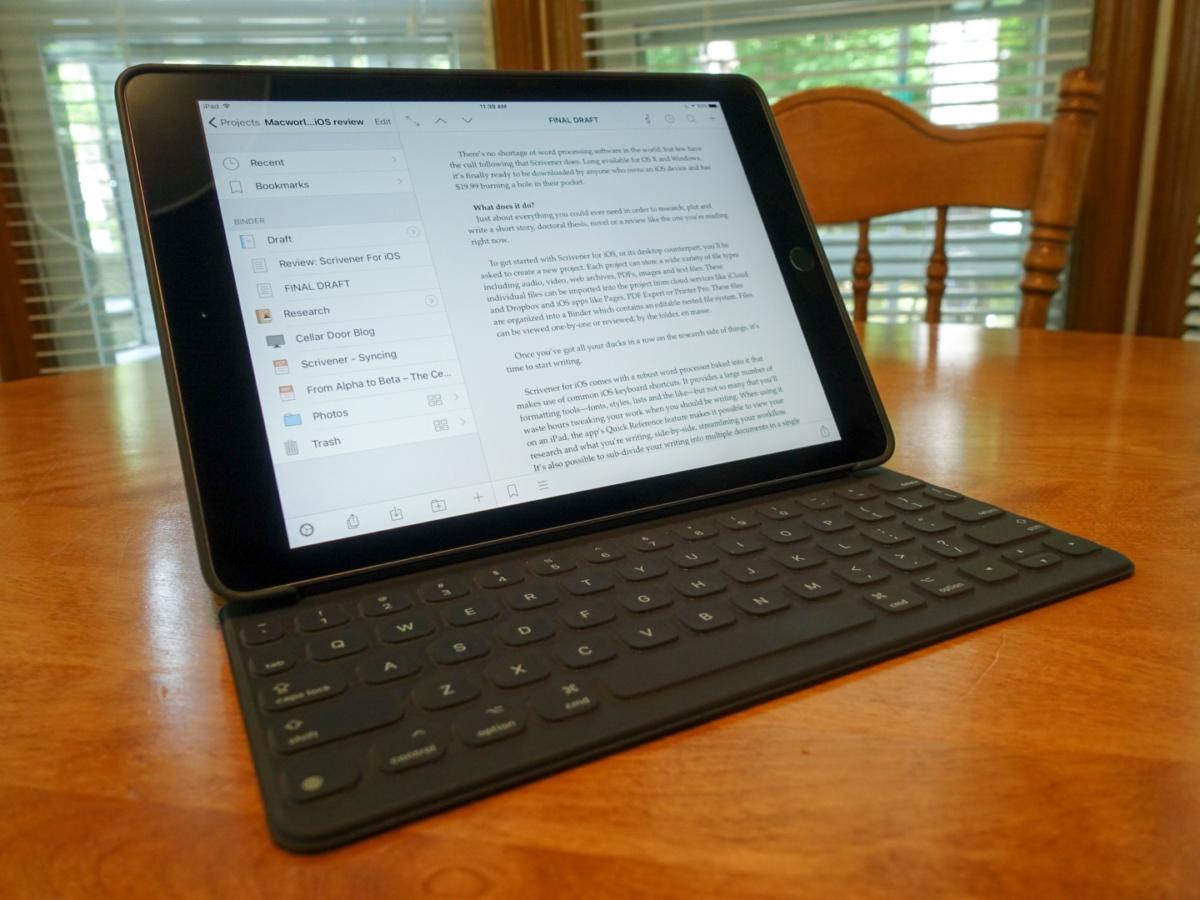
An iOS app sells separately for $19.99, and it can sync with the Scrivener Mac app, so long as you use iCloud or another online storage service, such as Dropbox, to save your work. With the app, you can edit or write from nearly anywhere. Many of the same functions for editing and rearranging your work, looking at reference material, and so forth, are also available in the mobile app. If you already own the iOS app, which works on both iPhone and iPad, you do not need to pay for any additional upgrades to it at this time. There is no Scrivener Android app.
No matter how you slice it, Scrivener's price is extremely competitive. The iOS app sounds expensive, but if you consider the fact that the final price is $65 for both the Mac and iOS app (and keep in mind that Scrivener is
Ulysses, which is one of Scrivener's primary competitors, recently started charging a recurring subscription fee of $4.99 per month or $39.99 per year. Formerly, it cost $44.99. Ulysses is Mac-only, however. Adobe Story charges a recurring $9.99 per month fee as well. Among writing apps, Adobe Story is in a different class, however, because it's designed for people to not just write but also produce scripts to be used in film and television production. For example, Adobe Story has tools for summarizing and tracking shoot locations.
The price for writing apps, in general, is all over the map. Storyist costs a flat $59, while Script Studio charges $199.95. Earlier I mentioned Final Draft, which costs a whopping $249.99—that's for a very specialized tool, however.
There's another class of writing apps that are considered distraction-free apps in part because they lack many features that might distract you. They tend to cost only $10 or so. iA Writer and WriteRoom are two examples. These apps are fine for short-form writing, but they don't the necessary tools, such as a sidebar library or binder, for organizing and revising longer pieces.
New in Scrivener 3
Version 3 contains significant improvements to Scrivener's design and functionality. An interface facelift freshens up the overall look of the app, making it much easier than it had been to stare at Scrivener all day long (such
Functionally, the compile feature has new improvements that make it more flexible and easier to use. Compiling is similar to exporting a project, but it is specific to writers' needs. For example, let's say you want to send a copy of a file to a publication for review, and this publication requires a specific font and line spacing. The publication also doesn't want your foreword at the time of submission. The compile features allow you to omit parts of your draft, such as the
Scrivener 3 includes a new Writing Statistics feature that keeps track of a wealth of information about your writing. Many writers like statistics so that they can make sure they hit a daily word count. Scrivener's statistics include even more information, such as the average paragraph length, average sentence length, and even the frequency of word use. It has tools for estimating the number of pages your text will take up in a paperback book.
A few other changes in version 3 include the ability to export to Epub 3, improvements to exporting to Kindle, enhancements to the outlining tools, and the ability to refer to up to four documents at a time in the main window with a new feature called Copyholders. On macOS specifically, Scrivener now supports the Touch Bar, and the underlying codebase was updated to make the whole app faster and more stable.
What Makes Scrivener Different?
What strikes me about Scrivener is how much more it looks like typical office software than other writing apps do. Menus, buttons, view modes, formatting tools, statistics, annotations, labels, keywords, uploads, and so forth. There's a lot to explore. More important, however, the app is well structured, which makes it easy to use.
The first time you launch Scrivener, you begin with an interactive tutorial, which helps you learn the ropes. The tutorial takes the form of a manuscript so that you're reading about the app while you're also using it. It makes sense, but the tutorial is epically long. Thankfully, you don't have to read all of it at once. Getting started is easy enough, and you can return to the tutorial pages whenever you're ready to learn something new.
With or without the tutorial, most people will be able to figure out how to create new pages and folders without much help. The interface will be familiar to anyone remotely comfortable with software programs in general. You compose in the center part of the interface and use the left pane to organize your files into folders. You can drag and drop files into different folders to rearrange their order. Using control+click on any file or folder opens up new options. The primary menu appears at the top. A few handy indicator icons show up at the bottom. It's all straightforward.
Within 5 or 10 minutes of poking around, I had thrown in a few dummy chapters of
The Composition Mode toolbar has character and word counts, a text zoom tool, inspector info (where you can put notes and metadata about the chapter or section for reference), keyword info, a slider for changing the width of the composition box, and more. I could see how one might make the case that there's too much stuff packed into Composition Mode, but at least most of it disappears when your cursor isn't at the bottom of the screen.
When starting a new project, you can begin from scratch with a blank page, or you can rely on one of Scrivener's many templates. Some of the options include
Notable Features
Scrivener includes WYSIWYG (what you see is what you get) formatting, which some other writing apps eschew. The belief is that formatting tools are the work of the devil, or at least that they distract writers from focusing on what's most important: the writing. If you have a tendency to spend hours playing with typefaces instead of typing, Scrivener might not be for you.
The benefit of WYSIWYG is its ease of
The writing app Ulysses uses
Scrivener 3 actually does support Markdown to some extent, but it's not fundamental to the software the way it is in Ulysses. You can import text with Markdown into Scrivener. There's a Copy Special option for copying Markdown text. Among the export options is a MultiMarkdown format. But most people who love writing in Markdown language probably won't love Scrivener the same way they might love Ulysses. Ulysses is designed for Markdown and Scrivener is designed for people more comfortable with WYSIWYG.
Another notable feature in Scrivener is its Corkboard view. Here you can look at your chapters or sections as if they were cards pinned to a board, and rearrange them by dragging and dropping. It's a handy organizational tool, especially for longer or more complicated works.
Final Draft has tools for making notes, too, and they're much more advanced than
One simple feature I love in Scrivener is Split Screen view. When enabled, it divides your writing window vertically and puts another view of the same content below. Whenever I revise material, I end up scrolling back and forth to check what I've already written. This Split Screen allows you to write in one window while referring to the same text in a second window without losing your place. The Split Screen view isn't unique to Scrivener, but it's useful enough to be worth mentioning.
Exporting and Collaborating
At the end of your writing phase, you'll probably want to get your manuscript out of Scrivener and into the hands of an agent or publisher. Scrivener offers a number of exporting options: HTML, DOC, DOCX, RTF, TXT, as well as OpenOffice (ODT), Final Draft (FDX), Final Draft 5-7 File Converter (FCF), and Fountain Screenplay (Fountain).
Scrivener doesn't have any native collaboration features, such as co-authoring tools or the ability to share a file with someone and let them add comments or make suggestions. Google Docs mastered that feat years ago, as did Final Draft. Even Evernote supports collaboration, as long as you buy the right tier of service. With Scrivener, collaboration capabilities simply aren't included, although you can hack your way to them using third-party tools, such as Draft. It takes some configuration, but it's possible.
Missing Pieces
Scrivener is rich in features, but there are still some significant improvements it could make. In an ideal world, I'd want all writing apps, Scrivener included, to offer storage and syncing natively, and for them all to have a web app. As mentioned, Scrivener can sync your files, but only if you use a third-party storage service, and only between devices that have the Scrivener app installed. If you're in a jam and need to use someone else's computer, you can't get at your work. If Scrivener offered a web app to paying customers, they could at least access any of their files in a pinch. An Android app would also be very useful.
It's fairly common to see a web app and native storage and syncing among note-taking apps, but not writing apps. Note-taking apps, however, often charge a recurring subscription fee, which you don't have to pay when you use Scrivener.
Native storage and syncing would also make it much easier to offer native file-sharing and collaboration. It's hard to have lived with the effortless collaboration capabilities of Google Docs for so many years and then realize Scrivener doesn't offer any collaboration at all. Final Draft does, but even in that app, only one person can edit a file at a time. And everyone who collaborates must own a copy of the rather expensive software.
Other writing apps I've tested have some neat features that don't make or break them but that are worth mentioning just to give a sense of what else is out there. In Ulysses, I was ga-ga over a really simple feature that let me preview a sample page of my manuscript before I exported it. It's a big deal because depending on what kind of export option you choose, you might want or not want comments and annotations to appear. I also liked being able to see how the final style and formatting would look before asking Ulysses spit out a 200-page PDF.
Built for Writers
Scrivener is one of the best apps for writers because it was built to give them the tools they need to draft ideas, compose words, edit, organize, and output their works. It's inexpensive, and the fact that you can install it on multiple machines adds value because you can work on your writing from any computer or iOS device with the app. That's not nearly as convenient as note-taking apps that come with their own storage and web apps, which allow you to get at your text from any device with a browser, but I'll take what I can get.
The app is packed with features that could take you a while to explore, but it's also structured in a way that lets you jump right in if you'd prefer to stick with the basics and just get on with writing. If Scrivener isn't what you need, I recommend trying Ulysses instead.
Scrivener
Bottom Line: Built with writers in mind, Scrivener 3 has everything you need to research, compose, organize, edit, and finish a piece of writing, all for a ridiculously reasonable price.
Please enable JavaScript to view the comments powered by Disqus.blog comments powered by Disqus