Check Hidden Files Dos
In computing, a hidden folder (sometimes hidden directory) or hidden file is a folder or file which filesystem utilities do not display by default when showing a directory listing. They are commonly used for storing user preferences or preserving the state of a utility, and are frequently created implicitly by using various utilities. They are not a security mechanism because access is not restricted - usually the intent is simply to not 'clutter' the display of the contents of a directory listing with files the user did not directly create.[1][2][3][4]
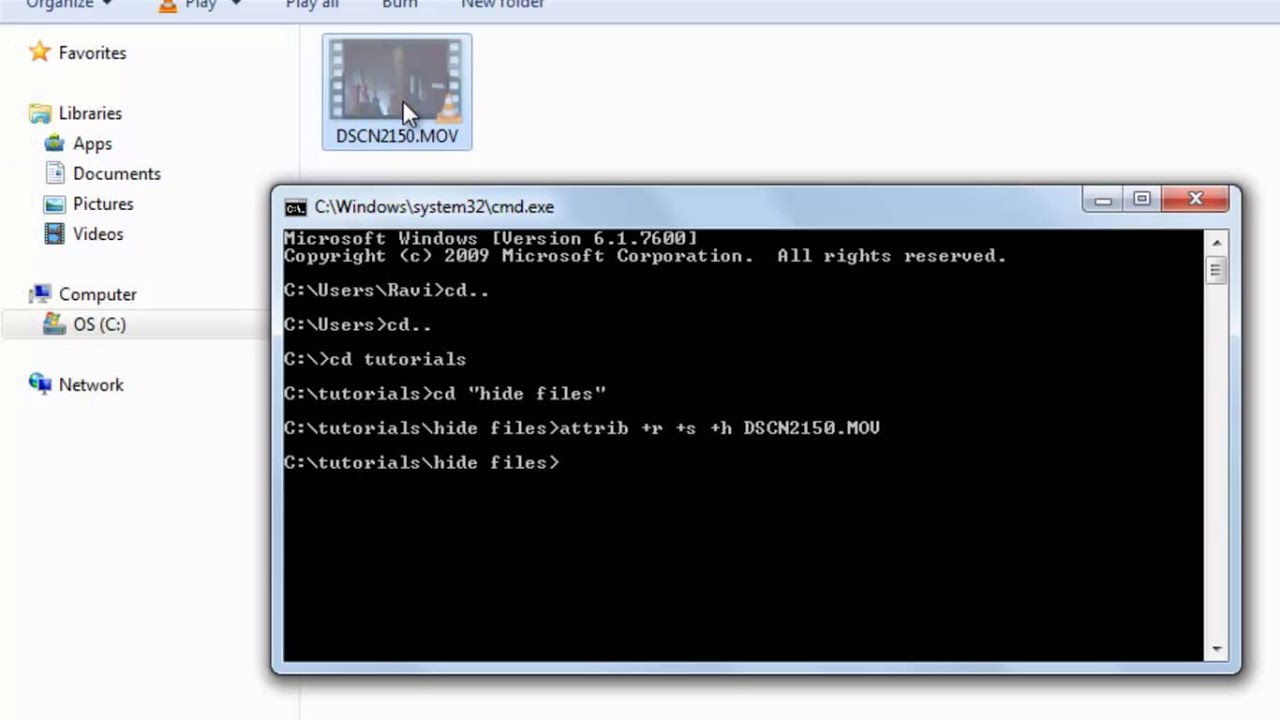
Show files hidden by a computer virus using command prompt. If you are certain you aren't the culprit, there is usually only one other cause - a computer virus. Before you panic at the idea of losing your files forever, you need to check to see if they are indeed lost or just hidden from plain sight. This article will guide you through the process of restoring hidden files via Windows Command Prompt. May 24, 2013. This is the most handy and easy way to unhide hidden files. All you need to do is open MS DOS command prompt, change drive to USB drive and type the attrib commands. Here's the details how to find hidden files in usb and also hidden folders with attrib. Press WINDOWS+R shortcut to open Run menu.
- 1Unix and Unix-like environments
Unix and Unix-like environments[edit]
In Unix-like operating systems, any file or folder that starts with a dot character (for example, /home/user/.config), commonly called a dot file or dotfile, is to be treated as hidden – that is, the ls command does not display them unless the -aflag (ls -a) is used. In most command-lineshells, wildcards will not match files whose names start with . unless the wildcard itself starts with an explicit . .
Show Hidden Files In Dos Virus
A convention arose of using dotfiles in the user's home directory to store per-user configuration or informational text. Early uses of this were the well-known dotfiles .profile, .login, and .cshrc, which are configuration files for the Bourne shell and C shell and shells compatible with them, and .plan and .project, both used by the finger and name commands.[5]
Many applications, from bash to desktop environments such as GNOME now store their per-user configuration this way, but the Unix/Linux freedesktop.orgXDG Base Directory Specification aims to migrate user config files from individual dotfiles in $HOME to non-hidden files in the hidden directory $HOME/.config[6].
Android[edit]
The Android operating system uses empty .nomedia files to tell smartphoneapps not to display or include the contents of the folder. This prevents digital photos and digital music files from being shown in picture galleries or played in MP3 player apps. This is useful to prevent downloaded voicemail files from playing between the songs in a playlist, and to keep personal photos private while still allowing those in other folders to be shared in person with friends, family, and colleagues. The .nomedia file has no effect on the filesystem or even the operating system, but instead depends entirely on each individual app to respect the presence of the different files.
GNOME[edit]
In the GNOMEdesktop environment (as well as all programs written using GLib[7]), filenames listed in a file named .hidden in each directory are also excluded from display. In GNOME's file manager, the keyboard shortcut Ctrl+H enables the display of both kinds of hidden files.
macOS[edit]
In addition to the 'dotfile' behaviour, files with the 'Invisible' attribute are hidden in Finder, although not in ls. The 'Invisible' attribute can be set or cleared using the SetFile command; for example, invoking SetFile -a V jimbo will hide the file 'jimbo'.[8] Starting in Mac OS X Snow Leopard, the chflags command can also be used; for example, chflags hidden jimbo will hide the file 'jimbo'.[9]
DOS and MS Windows[edit]
In DOS systems, file directory entries include a Hidden file attribute which is manipulated using the attrib command. Use the command line command dir /ah to display the files with the attribute of hidden.
Under Windows Explorer, the content of a directory can be hidden just by appending a pre-defined CLSID[10] to the end of the folder name. The directory is still visible, but its content becomes one of the Windows Special Folders.[11] However, the real content of this directory can still be seen using the CLI command dir.
References[edit]
- ^'What is a hidden file?', Microsoft.com
- ^'Configuring X: What are all those dotfiles for anyway?'. Linux Focus. March 1998. Retrieved 2013-09-08.
- ^'Sample .bashrc and .bash_profile Files'. Linux Documentation Project.
- ^Subodh Soni (2001-12-01). 'Understanding Linux configuration files'. IBM Developer. Retrieved 2019-04-26.
- ^One user could lookup another by using the command along with the username (and hostname if not on the local host), and the finger service would respond with the other user's current status, and the contents of the
.planand.projectfiles in that user's$HOMEfolder. - ^Bastian, Waldo; Lortie, Ryan; Poettering, Lennart (November 24, 2010). 'XDG Base Directory Specification'. Retrieved June 4, 2014.
- ^'GLib commit: Support for .hidden files'. Retrieved 2013-08-07.
- ^
SetFile(1)– Darwin and macOS General Commands Manual - ^
chflags(1)– Darwin and macOS General Commands Manual - ^Canonical Names of Control Panel Items
- ^The Secret BEHIND the Windows 7 “GodMode”
External links[edit]
- Bellevue Linux Users Group: Hidden files in Unix-like operating systems at the Wayback Machine (archived October 17, 2007)
- Computer Hope: Microsoft DOS attrib command
| More UNIX and Linux Forum Topics You Might Find Helpful | ||||
| Rsync - how to copy hidden folder or hidden files when using full path | Hello. I use this command : rsync -av --include='.*' --dry-run '$A_FULL_PATH_S' '$A_FULL_PATH_D'The data comes from the output of a find command. And no full source directories are in use, only some files. Source example...... Shell Programming and Scripting | 2 | ||
| List all directories hidden or not hidden | servus | I want to list all directories hidden or not hidden. ls -ld */ => shows only not hidden directories so i guess the answer would be to add the a option to show all files ls -lad */ => not working :confused: ls -la grep '^d' => works But I would like to know why I can't use ls -lad...... UNIX for Dummies Questions & Answers | 4 | |
| Locating a hidden file | MaRiOsGR | it seems one of my server's account was compromised. I caught a perl script running a hack/attack script: 20:23 /usr/bin/perl ./up **.**.**.** 0 120 I've disabled the user etc, but I cannot find the script 'up' anywhere in the server. I tried using locate or find. any ideas?... UNIX for Dummies Questions & Answers | 1 | |
| Finding Hidden files and protecting the folder containing hidden files from deletion | pochaw | Hi. I have a script which is deleting files with a particular extension and older than 45 days.The code is: find <path> -name '<filename_pattern>' -mtime +45 -exec rm {} ; But the problem is that some important files are also getting deleted.To prevent this I have decide to make a dummy...... Shell Programming and Scripting | 4 | |